While my course of study is Industrial Design and not Human Centered Computing (or even Human Computer Interaction), I have found a tremendous overlap in both purpose and method amongst the fields. This viewpoint causes the lessons and material of HCC to reflect upon and influence design and vice-versa. Hopefully this will lend both outside influence to the maturing field and be of greatest benefit to myself in applying what I’ve learned to my further education and career.
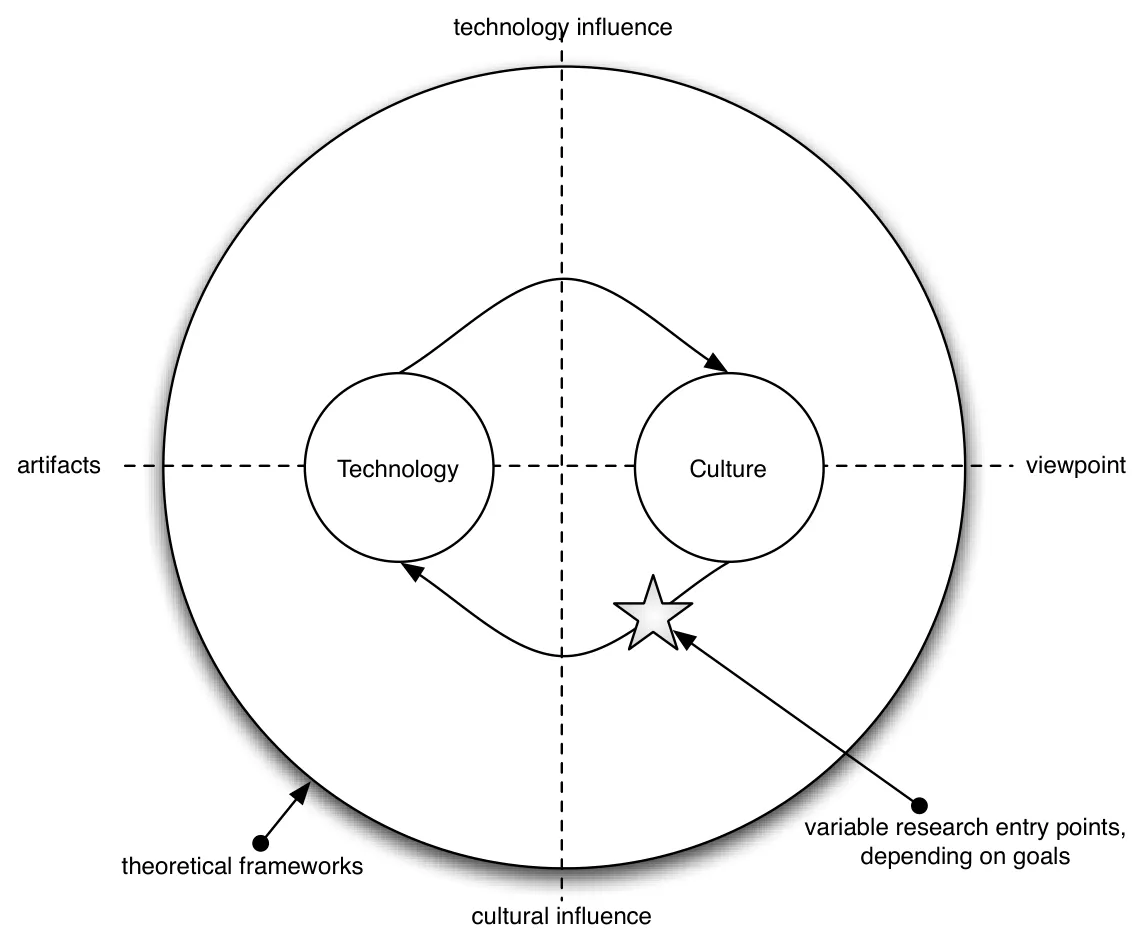
As computers become smaller, more powerful, and less expensive, they will grow in abundance and take on a greater number of tasks and responsibilities. While much of technology’s growth is typically associated with engineering advances, the understanding of how people value and make sense of this technology is needed for appropriate and successful development. This places HCC at a very interesting intersection of sociology, computer science, psychology, and many forms of design. HCC focuses its primary attention on learning about and understanding people within contexts relating to computer technology. While this understanding is in itself a goal, the products created feed back into the culture that produced them in a continuous yin-yang, push-pull, cycle of production and consumption. Culture is shaped and influenced by the technologies it produces and technologies advance in direction controlled by cultural pressures.
Breaking into this cycle requires defining an approach. I have formulated the following process from the projects and progress of the class as well my design-project experience:
-
Define Realm: This is the highest level scoping of a HCC research project. Deciding on what realm to research is most directly influenced by the current period’s technology and culture. The realms included over the course of this class included digital photography, wikipedia, and wifi. This level sets the playing field and generally helps if the researcher has at least an interest, if not some prior knowledge of the subject-matter.
-
Breadth of topic: Once the general bounds are established, the researcher starts filling-out the space with what work has been done, who has done it, and the methods and theories popular to that topic. This is wide and shallow research done to note areas of continuing or developing problems. At this point, it is important to ask and create more questions than finding answers.
-
Focused sub-area: The array of questions, existing problems, and previous work will bring research opportunities to light. Having gained an overview of existing research, this step begins a narrow and deep analysis of a sub-area within the topic. A group of stakeholders will be defined and the primary and related areas of questioning will be created.
-
Method: The specific method of data collection will vary with the project goals, though a certain amount of repeatable, consistent elements, exist in creating a usable methodology. Targeting the chosen stakeholders, the type of information a researcher is attempting to mine must be converted to a definitive set of questions. The number of subjects, setting, and influencing variables should be determined. By referring to previous research efforts for successful or failed methodologies, a researcher can better guarantee quality feedback. There can also be a great deal of creativity in the methods designed to elicit feedback, though reliability of data and its controlled connection with the primary line of questioning should be of foremost importance.
-
Framing Theory: The data collected through research can be organized and viewed through a number of lenses to better help draw conclusions. Much as the chosen methodology will vary with the type of research and questioning, some theories are better conceptual tools in making sense of a domain than others. Studies with a heavy interaction between people and artifacts in a single task or system could be understood through distributed cognition, while individualcentered and process oriented understanding could be viewed using activity theory. In the case of design-based research, the results may not correspond with or test an existing theory. It is possible for research results of this nature to merge disparate ideas, previous findings, and discovered data on complex social situations into a new defining framework.
-
Repeat: Having completed this process, the results may require iterative cycles to further define understanding. The product of one cycle may be the basis for yet another study.
Below I have assembled a graph that follows the division and connection of technology and culture through HCC. The four axes are of technology’s affect on culture vs culture’s affect on technology and the division of people’s viewpoints vs the artifacts they create. Viewpoints consider how people live, work, create meaning, and understand the world around them. Artifacts look at the things that people create through history and how value and meaning are realized. Readings over the course of the semester blur and cross these boundaries quite indiscriminately though I have sorted some papers into these groupings. There is certainly room for debate, but isn’t that the fun and learning?
Viewpoint: Four Paradigms of Information Systems Development (Hirschheim & Klein), Abstraction of Industrial Work (Zuboff), Two Theories of Home Heating Control (Kempton), An Anthropologist Visits the Laboratory (Latour)
Artifacts: Building Thought into Things (de Léon), The Icebox Goeth (Nunberg), Doing Cultural Stud- ies, The Story of the Sony Walkman (du Gay et al), Shearing Layers (Brand), The Industrial Revolution in the Home (Cowan)
Theoretical Frameworks: How a Cockpit Remembers Its Speeds, (Hutchins), Activity Theory as a Poten- tial Framework for Human-Computer Interaction Research (Kuutti), Situated Learning: Legitimate Pe- ripheral Participation, (Lave & Wenger)